Friday, May 20, 2011

NYC Vintage Image: Kaleidoscope Cabbies, 1960s

In 1967, New York City ordered all "medallion taxis" be painted yellow to help cut down on unofficial drivers and make official taxicabs more readily recognizable. Imagine a day when you might see this kitschy psychedelic number on the right. Photo: early 1960s...
 Taxis from beyond "vintage": 1890, 1900 and 1973...And, of course, below, the taxis of today, though Bloomberg's approved "green" cabs of the future, which look like hunchback bugs, will soon make NYC even more of a laughing stock than he's already accomplished (i.e.: "Don't you dare smoke out of doors. It's dangerous!").

Thursday, May 19, 2011

NYC Vintage Image: The First Great Depression, 1935

During the first Great Depression, out-of-work New Yorkers line up in front of employment agencies desperately in search of jobs, along 49th Street in 1935.
Sadly, this is one vintage image we are reliving again. Despite news reports that have termed the economic collapse of 2007 as a "recession," statisticians recognize that is pure bunk. Indeed, we are now enduring the Second Great Depression.

Wednesday, May 18, 2011

Wowsah! 'Reach The Sky' by A.G. Photographe

Photos by A.G. Photographe's buddy icon

NYC Image: Future New York, 'The City of Skyscrapers,' 1910s

Well, it didn't quite turn out this way... This 1910s postcard from Walker Evans imagines the future of New York, "The City of Skyscrapers," offering a system of elevated trams that cut through buildings, massive skywalks, rickety but plentiful air travel, few cars on ground level and—the reality—a landscape of proud towering skyscrapers as far as the eye can see.

 The back reads: "Future New York will be pre-eminently the city of skyscrapers. The first steel frame structure regarded as a skyscraper was the Tower Building at 50 Broadway, a 10-story structure 129 feet high. There are now over 1,000 buildings of that height in Manhattan. The best known skyscrapers are the Singer Building, the Metropolitan Building and the Woolworth Tower, which towers above them all and rises to a height of 790 feet. The proposed Pan American Building is to be 801 feet high."

This reminds me of another fantasy of "future New York": rebuilding the World Trade Center. The once-deemed Freedom Tower was supposed to reach rooftop level by the end of 2010 with topping out in 2011. Estimated completion of the tower was then pushed back to 2013. Today, 10 years after toppling, it stands all of 12 stories. Seems to me we were much more accomplished in the 1910s than the 2010s.

Tuesday, May 17, 2011

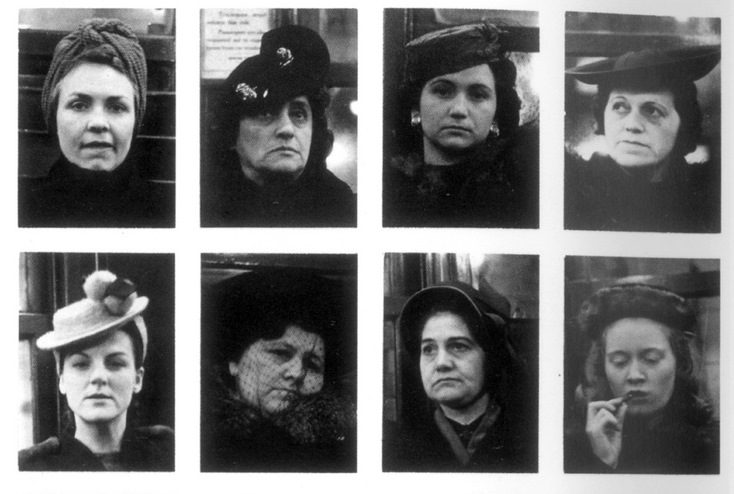
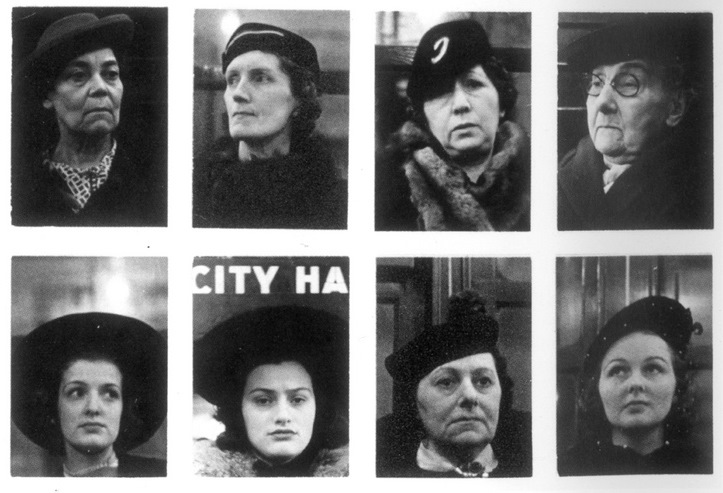
NYC Vintage: Walker Evans' 'Subway Portrait 16 Women," 1938-1941

American photographer Walker Evans, best known for his iconic images documenting the Great Depression, surreptitiously shot portraits of passengers in the New York subway between 1938 and 1941, riding with a camera concealed under his coat, fitted with a shutter release running inside his sleeve. In 1959, Evans assembled 16 of the images into "Subway Portrait," which in 1966, were exhibited at New York’s Museum of Modern Art.

Monday, May 16, 2011

NYC Image: Toffenetti Restaurant, 'Famous For Ham & Sweets'

Toffenetti’s, the "Cathedral of All Restaurants," at the corner of Broadway and 43rd, "where glamour sparkles forever," opened in 1940, serving an astounding 8,500 meals in its first day. Established by Austrian immigrant Dario Louis Toffenetti, the restaurant became a staple in Times Square for nearly 30 years.

Born in 1889, Toffenetti came to the U.S. in 1910, selling baked potatoes at a Wisconsin mining camp, before becoming a bus boy at Chicago’s Sherman House. In 1914, he opened his first restaurant there, followed by a second in 1921 and six by 1937.

As advertising, marketing and public relations advanced, the entrepreneur offered elaborate descriptors for his menu items. Ham was “Roast Sugar Cured Ham” with accompanying copy, a la “These hams are cut from healthy young hogs grown in the sunshine on beautifully rolling Wisconsin farms, where corn, barley, milk and acorns are unstintingly fed to them, producing that silken meat so rich in wonderful flavor.”

His potatoes were “bulging beauties, grown in the ashes of extinct volcanoes, scrubbed and washed, then baked in a whirlwind of tempestuous fire until the shell crackles with brittleness.”

Following the New York World's Fair in 1939-1940, he outbid Louis B. Mayer for a premiere spot in Times Square, and designed a a two-story, glass-fronted modern building, with an escalator and open  stainless steel kitchen. There, Toffenetti became famous for his Old Fashioned Louisiana Strawberry Shortcake, "topped with pure, velvety whipped cream like puffs of snow."

To build trust, he featured himself in his ads. When Prohibition ended, he announced he would serve beer, but not "in any fashion that might offend our most fastidious women patrons." Toffenetti died in 1962 and his sons, lacking the charm and drive of their papa, closed the iconic locale in 1968.
Toffenetti’s in New York, The Heart of the Great White Way. The Finest of Food and Liquor at Popular Prices.

Saturday, May 14, 2011

NYC's Historic Trinity Church, Part Deux

I've had the best possible reason to return to the southern tip of Manhattan in the last couple days, following previous posts covering Trinity Church and Bowling Green: It's work, cool cats! I'm delivering written content for a soon-to-launch webbie that not only has great potential, but focuses on one of the great loves of my life: New York City. Nothing more to say for now... so let's return to the Trinity memorial park. Last post was on the south side of the historic church; now we shift to the north.

NYC Vintage Image: Penn Station Hustle & Bustle, 1941

A glorious 1941 interior shot showing hustle and bustle at 1:35 p.m. in the original Penn Station at West 33rd Street and Broadway, from The Herald Tribune. Note the soldiers in uniform, women in festive traveling hats and men in suits and hats.

Friday, May 13, 2011

Bowling Green: Iconic Images Of The Southern Tip Of NYC

Bowling Green, at the foot of Broadway in Lower Manhattan, is the oldest public park in New York City, built in 1733. At its northern end is the Charging Bull sculpture, at the south is the Alexander Graham Custom House, which now hosts the happy New York branch of the Smithsonian Institute and NYC's less jolly Bankruptcy Court.

Wednesday I took a stroll down to the tip of the island, and captured a few of the iconic images in and around Bowling Green, which is listed on the U.S. National Register of Historic Places.
Alexander Graham U.S. Custom House, completed 1907.
1 Broadway, former office building formerly known as United States Lines-Panama Pacific Lines Building, completed 1884. (Today, Citibank and an attorney practice.)
26 Broadway, the majestic, novel Standard Oil Company Building, completed 1928.
Charging Bull, 7,100 pounds of bronze muscle, installed 1989.
And of course, how could we forget Wall Street icon SpongeBob Squarepants, who first aired on Nickelodeon in 1999.

Thursday, May 12, 2011

NYC Vintage Image: Women's Working Hotel, 1878

In 1877, wealthy merchant A.T. Stewart commissioned the handsome Stewart's Hotel for Working Women at Fourth Avenue (now Park Avenue) between 32nd and 33rd Streets, to provide safe housing for the influx of single working women into New York City. That certainly didn't last long: It was opened in April 1878, closed in May and reopened in June as the Park Avenue Hotel.How about that boffo bedroom?!
Below is an image of the post Working Women's Hotel, as the Park Avenue Hotel, with patriotic bunting and a horse-drawn carriage parked at the entrance. Poor Mr. Stewart; this venture didn't pan out, either. The building was demolished in 1927.
Below is a view from the Park Avenue Hotel rooftop, looking up Park Avenue, with horses and carts ambling the avenue. At the north end is Grand Central Depot, which was torn down for the current Grand Central Terminal in order to handle the onset of electric locomotives.